
Fidelity Bank Founder Edward Effah Recalls Modest Start as Bank Turns 20
Fidelity Bank founder Edward Effah says he used £40,000 in savings, his own car and a $25,000 loan from a friend to fund his stake when building the business that became the bank, which is marking 20 years of operations.
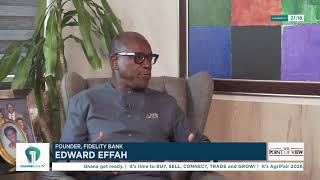
Edward Effah, the founder of Fidelity Bank, has described how he pooled about £40,000 in savings, his personal car and a borrowed $25,000 to fund his stake in the venture that grew into the bank, which is now marking 20 years in operation.
Mr Effah shared the account in an interview with Bernard Avle on Channel One TV’s The Point of View on Monday, November 9, 2026, as first reported by Citi News.
He said he qualified as a chartered accountant in London and worked with the financial services firm Rudolph Wolf before concluding that he did not want to remain in the United Kingdom for the rest of his life.
According to Mr Effah, watching Ghanaian professionals in the UK lose their jobs during economic downturns strengthened his resolve to come home, build a business and contribute to the country’s development.
Also read: KKD Urges Ghana to Treat Fashion as an Engine for Tourism and Jobs
He said the rise of privately owned banks in emerging markets during the 1990s, including GT Bank in Nigeria, Equity Bank in Kenya and ICICI Bank in India, inspired the founders to create an institution that could match global banks in vision, strategy and standards.
“Because in the long term, it’s your country, you’ll be able to contribute something back and have your destiny in your hands,” he said.
Mr Effah explained that his original plan on returning was to set up an investment banking boutique. He later teamed up with a friend, Harper Randawa, to launch a discount house alongside the boutique, and the business went on to move into private equity, venture capital and asset management.
He said the founders had initially hoped to create a Ghanaian version of Goldman Sachs. However, the arrival of online trading platforms, which let banks deal directly with each other, reduced the role of discount houses as middlemen in the wholesale money market.
That change, he said, led the team to rethink their model and turn to commercial banking, where they saw room for a world-class bank offering products and services not then easily found in Ghana.
Recalling the early financial strain, Mr Effah said he was 33 when he started drawing up the business plan in 1995 and had little money of his own. Most of the roughly £40,000 he brought back from London went into registering the company, preparing the plan, engaging consultants and covering other start-up costs.
He said he handed over his personal vehicle to the company as part of his equity contribution and took a loan of about $25,000 from a friend to complete his investment.
Mr Effah said raising money from people who had placed their trust in him made the prospect of failure especially frightening, adding that survival, rather than profit, was the early priority.
“So the fear of failure keeps you going,” he said.
Despite the tight finances, he said the business performed well from the outset, with the discount house turning a profit and paying dividends in its first year and in the years that followed.
Source: Citi News. This story was prepared with the help of AI from that reporting, and checked by our editors.



Comments
Sign in to join the conversation.